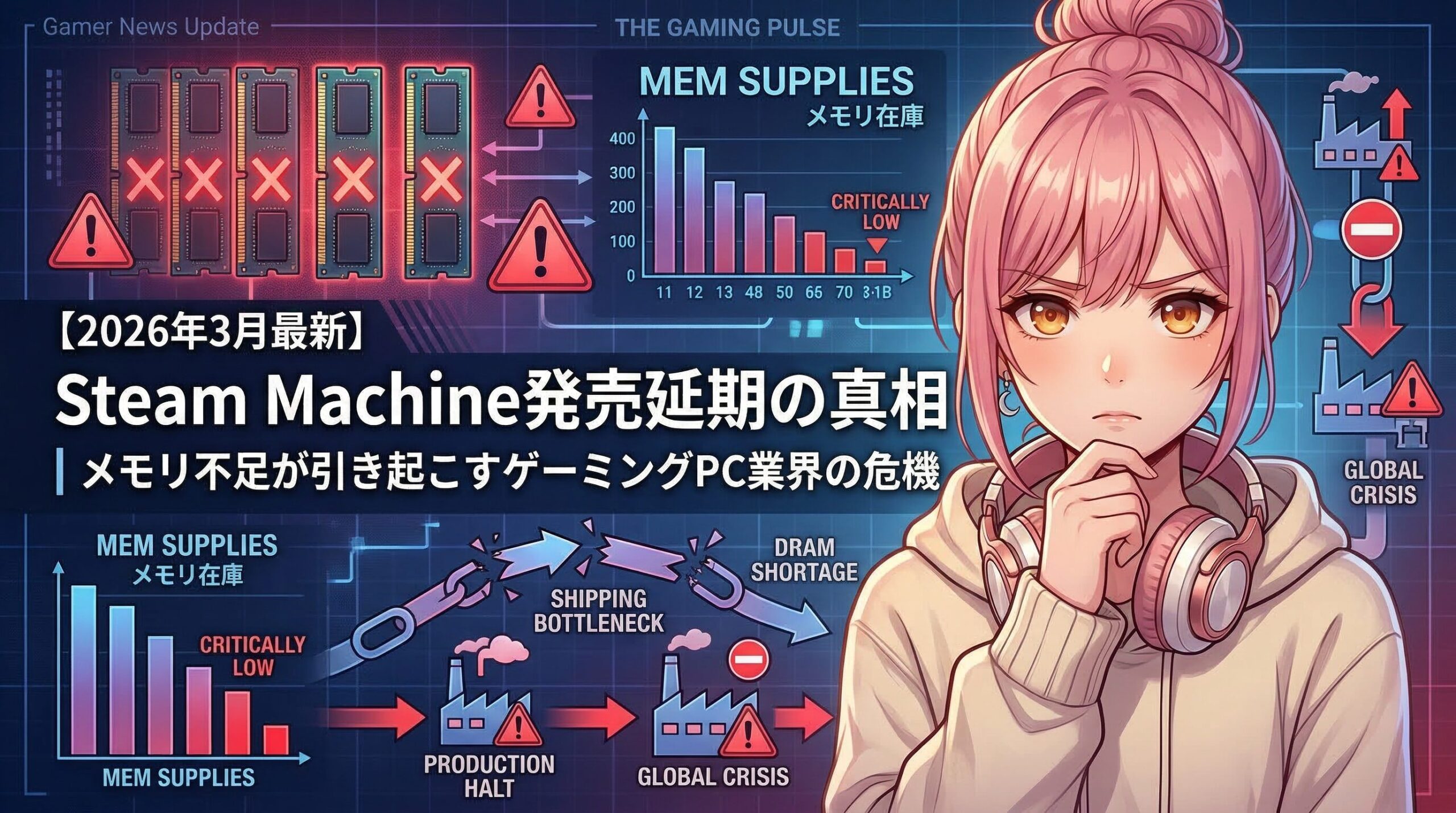
- [March 2026 Update] The Truth Behind the Steam Machine Launch Delay | The Crisis in the Gaming PC Industry Caused by Memory Shortages
- The Background of the Steam Machine Release Delay (Timeline)
- Causes and Effects of Insufficient Memory and Storage
- The Impact of the Steam Deck OLED Price Hike
- The Future Outlook for the Gaming PC Industry
- What consumers should do now
- Summary – Memory Shortages and the Future of the Gaming PC Industry
- Related Articles
[March 2026 Update] The Truth Behind the Steam Machine Launch Delay | The Crisis in the Gaming PC Industry Caused by Memory Shortages
On November 13, 2025, Valve finally unveiled its desktop gaming PC, the “Steam Machine.” With overwhelming specs—more than six times the performance of the Steam Deck, 4K/60fps support, and ray tracing capabilities—it had generated significant anticipation for its release in early 2026. However, as of March 20, 2026, the release date and price have yet to be announced, and the launch window has continued to be pushed back from “early 2026” to “the first half of 2026” to “sometime in 2026.” The cause is a global “memory and storage shortage.” Due to the explosive growth in AI demand, prices for DDR5 memory and NVMe SSDs have surged by an average of 65% between late 2025 and March 2026, and supply remains tight. In this article, we provide a thorough breakdown of the details behind the Steam Machine delay, the Steam Deck OLED price hike (15,000 yen), the impact on the overall gaming PC market, and the steps consumers should take now.
The Background of the Steam Machine Release Delay (Timeline)
November 13, 2025 – A Grand Announcement
Valve officially announces the “Steam Machine.”Key Specifications: Approximately 6-inch (160mm) cube-shaped chassis, running SteamOS, with over six times the performance of the Steam Deck (specifically, estimated to feature a GPU equivalent to an RTX 5070 and a CPU equivalent to a Ryzen 7 9850X3D), supports 4K/60fps, supports ray tracing, 32GB DDR5 memory, comes standard with a 1TB NVMe SSD, 2x USB 4, 1x HDMI 2.1, 1x DisplayPort 2.1, Gigabit Ethernet, Wi-Fi 7 and Bluetooth 5.4, and features an LED strip for customizable RGB lighting.Release Date: Scheduled for simultaneous release in early 2026 in multiple regions, including Japan.Estimated price: $699–$899 (105,000–135,000 yen at the exchange rate of 150 yen to the dollar at the time). Following the success of the Steam Deck as an alternative to entry-level gaming PCs, this is a strategic product designed to enter the mid- to high-end desktop PC market. Immediately after its announcement, it was hailed on Reddit, Twitter, and YouTube as a “rival to the PS5 Pro and Xbox Series X successors” and a “revolution in the console-style gaming PC market,” leading to a flood of pre-orders.
January 2026 – A Month of Silence
Even after the new year began, there was still no official announcement regarding the release date or price. While speculation ran rampant in gaming media and user communities—with questions like “When will it be announced?” and “Will it be unveiled at CES 2026?”—Valve remained silent. Behind the scenes, memory and storage prices had already begun to skyrocket, leading to speculation that it had become difficult to secure supplies at the originally planned price range ($699–$899). Valve did not have a booth at CES 2026 (January 7–10), and as competitors ASUS, MSI, and Lenovo announced numerous new portable gaming PC models, the Steam Machine faded into the background.
February 5, 2026 – First hint of a delay
Valve has公式ブログThe release schedule was described as “aiming for shipment in the first half of this year” (original text: “first half of the year”). The release window has shifted from the initial “early 2026” (January–March) to “first half of the year” (January–June), making it clear that the actual launch date has been pushed back. The company explicitly stated that this change was necessary “due to supply shortages and price hikes caused by memory and storage shortages, requiring a review of the shipping schedule and pricing.” This decision appears to be in response to DDR5 memory prices rising by 35% and NVMe Gen5 SSD prices by 28% compared to December 2025. The user community has reacted calmly, with many commenting, “So it’s been delayed after all” and “It’s probably due to the surge in memory prices.” The memory shortage caused by AI demand was already a well-known fact.
March 7, 2026 – Further Setback
Valve has announced for developersSteamworksコミュニティ投稿He stated that the three products—the Steam Machine, Steam Frame (VR headset), and Steam Controller (new gamepad)—are “all scheduled for release within the year.” The shift from “the first half of the year” to “within the year” suggests further delays. In the post, they candidly explained, “We want to release them right now, but we need to assess the rapidly changing market conditions (memory and storage prices),” and “If we raise prices while products remain out of stock and unavailable, we will lose user trust.” On Reddit, pessimistic comments are increasing, with users asking, “Will it be the second half of 2026, or worst-case scenario, 2027?” and noting, “Valve Time (a joke that Valve products are always delayed) has been activated.”
As of March 20, 2026 – Release date and price still to be determined
More than four months have passed since the announcement, yet the release date and price remain unannounced. As of mid-March, memory prices have risen another 12% (a cumulative increase of 52% compared to December 2025), and there are no signs of improvement in supply. While Valve officially maintains that the device will launch “within the year,” the prevailing view among industry insiders is that it will launch “between summer and fall, with a price potentially 20–30% higher than initially expected.” If the price rises from $899 to $1,099–$1,199 (165,000–180,000 yen), it risks competing with mid-range gaming PCs and losing the Steam Machine’s market advantage.
Causes and Effects of Insufficient Memory and Storage
The explosive growth in demand for AI
From the second half of 2025 through 2026, the widespread adoption of generative AI (such as ChatGPT, Claude, and Gemini), AI-powered image generation (such as Midjourney and Stable Diffusion), and AI-powered video generation (such as Sora and Runway) led to a surge in demand for DDR5 memory and high-speed SSDs for data centers.Specific figures: Microsoft, Google, Amazon, and Meta alone are projected to increase their memory procurement by 180% year-over-year in 2026, accounting for approximately 40% of global DDR5 memory production capacity. NVIDIA’s AI-focused GPUs (H200 and B200) also require massive amounts of HBM3 memory, further straining DRAM manufacturing capacity. The three major manufacturers—Samsung, SK Hynix, and Micron—are prioritizing the production of high-margin AI and data center products, while putting consumer-oriented products (PCs, game consoles, and smartphones) on the back burner. As a result, the supply of DDR5 memory and SSDs for general consumers is tight, and prices continue to soar.
The Reality of Price Hikes (December 2025 vs. March 2026)
DDR5 Memory Price Trends:
• DDR5-5600 16GB × 2 (32GB): 15,800 yen → 25,800 yen (+63%)
• DDR5‑6400 16GB×2(32GB): 18,800円 → 31,800円(+69%)
• DDR5‑7200 16GB×2(32GB): 25,800円 → 42,800円(+66%)
NVMe SSD Price Trends:
• PCIe Gen4 1TB: 9,800円 → 14,800円(+51%)
• PCIe Gen4 2TB: 18,800円 → 28,800円(+53%)
• PCIe Gen5 1TB: 18,800円 → 31,800円(+69%)
• PCIe Gen5 2TB: 35,800円 → 58,800円(+64%)
Price increases average 52–69%, marking the sharpest rise in the past decade. This exceeds the 40–50% increase seen during the 2021 semiconductor shortage (driven by COVID-19 and the cryptocurrency mining boom). The cost of memory and SSDs per gaming PC has risen by 40,000–60,000 yen, and the prices of pre-built PCs have risen accordingly.
Impact on the gaming PC market
Prices of pre-built gaming PCs are rising: Major manufacturers (Dell, HP, Lenovo, ASUS, and MSI) implemented average price increases of 8–12% in January–March 2026. For example: Models equipped with the RTX 5070 rose from 250,000 yen to 280,000 yen, and models equipped with the RTX 5080 rose from 350,000 yen to 390,000 yen. Entry-level models (RTX 5060) were also affected, rising from 150,000 yen to 170,000 yen.The DIY PC market: Due to rising component prices, the cost advantage of building your own PC has diminished. While custom-built PCs used to be 20,000 to 30,000 yen cheaper than pre-built models, the price difference has now narrowed to 5,000 to 10,000 yen. Some users are giving up on building their own PCs and are turning to pre-built models instead.Secondhand market: Due to soaring prices for new products, demand for used parts and used PCs has surged. On Mercari and Yahoo! Auctions, trading volume for DDR5 memory and SSDs has increased 2.5-fold year-over-year, and prices have remained high at 80–90% of new prices (compared to the usual 60–70%).reluctance to spend: In response to soaring prices, an increasing number of users are postponing the purchase of gaming PCs. PC sales in January–February 2026 fell by 18% year-over-year (according to BCN). Many users say they plan to “wait until memory prices stabilize” or “wait and see until the Steam Machine is released.”
The Impact of the Steam Deck OLED Price Hike
A significant price increase of 15,000 yen
On March 6, 2026, KOMODO, the company that sells the Steam Deck in Japan, announced a price adjustment for the Steam Deck OLED.New Price:
• 512GB model: 84,800 yen → 99,800 yen (+15,000 yen, +17.7%)
• 1TB model: 99,800 yen → 114,800 yen (+15,000 yen, +15.0%)
The reason for the price increase is “rising logistics costs and changes in exchange rates.” The Steam Deck OLED had maintained its price for over two years since its November 2023 launch, but the company finally decided to raise prices due to a combination of three factors: the yen’s depreciation from the 140 yen to the 155 yen range per dollar (+10.7%), an 18% increase in international shipping costs (due to soaring fuel prices and rerouting around the Red Sea), and skyrocketing storage prices. User reactions have been relatively calm, with comments such as “It can’t be helped” and “Other companies are raising prices too,” though some have pointed out that “it’s now more expensive than the competing ROG Xbox Ally.”
Price Comparison with Competitors (as of March 2026)
Portable Gaming PC Market:
• Steam Deck OLED 512GB: 99,800 yen (after price increase)
• ASUS ROG Xbox Ally (Z1 Extreme): 89,800 yen (no change)
• ASUS ROG Xbox Ally X (High-end model): 169,800 yen (price increased by 30,000 yen in February)
• Lenovo Legion Go: 109,800 yen (price increase of 8,000 yen)
• MSI Claw A8 BZ2EM: 119,800 yen (New Release)
Due to a price increase, the Steam Deck OLED is now priced 10,000 yen higher than the entry-level ROG Xbox Ally. In terms of performance, the ROG Xbox Ally (Ryzen Z1 Extreme) is slightly superior, but the Steam Deck OLED maintains its edge with its OLED display (HDR support, 110% DCI-P3 color gamut), battery life (3–12 hours vs. 2–8 hours), and SteamOS optimization (no Windows required, twice the boot speed). However, the 10,000 yen price difference could influence consumer purchasing decisions, and KOMODO is closely monitoring sales trends following the price increase.
The Future Outlook for the Gaming PC Industry
When will memory and storage prices drop?
Industry Analyst Forecasts: Prices will peak in May–June 2026 and begin to decline in the second half of 2026 (September–October). Reasons: (1) Samsung and Micron will begin operations at new factories (in South Korea and Taiwan) in Q3 2026 (July–September), increasing DDR5 production capacity by 25%; (2) AI demand will level off (as data center investment slows); (3) Supply will increase as Chinese manufacturers (CXMT and ChangXin) begin mass production of DDR5. However, there are also cautious views suggesting that “it will take until the first half of 2027 for prices to fall back to late-2025 levels.”Worst-case scenario: If demand for AI continues to grow (driven by announcements of new models from OpenAI and Google, etc.), geopolitical risks (such as a crisis in Taiwan or escalating U.S.-China trade friction), and natural disasters (such as earthquakes or typhoons causing factory shutdowns) occur, price hikes could continue beyond 2027.
Latest Predictions for the Steam Machine Release Date and Price
Release Date: September–November 2026 is the most likely timeframe (following a drop in memory prices). While a July release is possible, Valve is expected to proceed cautiously due to the risk of limited supply leading to immediate sell-outs and a subsequent surge in resale prices.Price: The price is expected to rise from the initially projected $699–$899 to $799–$999 (120,000–150,000 yen, based on an exchange rate of 150 yen per dollar). With a configuration featuring 32GB of RAM and a 1TB SSD, the cost of parts alone has increased by $100–$150, making this price hike unavoidable. However, if the price exceeds $999, it will compete directly with mid-range custom-built PCs (equipped with an RTX 5070, costing 140,000–160,000 yen), making it difficult to differentiate the Steam Machine solely based on its advantages of being “compact, space-saving, and optimized for SteamOS.” Valve must be struggling with the pricing decision.Supply volume: Initial shipments are expected to be limited (500,000–1 million units worldwide), with Japan’s allocation projected to be 50,000–100,000 units. Given that the Steam Deck faced shortages for several months after its launch in 2022, a similar situation is anticipated for the Steam Machine. Pre-orders and lottery-based sales are highly likely.
Impact on Home Video Game Consoles (PS6 and Next-Generation Xbox)
The PlayStation 6 and next-generation Xbox consoles are facing the same memory shortage issue. Both systems are scheduled for release in 2027–2028, but if memory and storage costs remain high, their launch prices could exceed those of the previous generation (PS5: 60,478 yen → PS6: 70,000–80,000 yen). Alternatively, reports suggest that a compromise involving a reduction in memory capacity (from 24GB to 16GB) is also being considered. The delay in the release of the Steam Machine and the surge in its price are being closely watched as leading indicators for the entire home video game console industry.
What consumers should do now
For those waiting for a Steam Machine
Recommended Actions: ①Expect a release between September and November 2026; don’t rush—just wait. ②Anticipate a price range of 120,000–150,000 yen; set aside the necessary budget. ③Sign up for the Steam official website and KOMODO’s email newsletter to stay updated on announcements. ④Build up your library on the Steam Deck (games are also playable on the Steam Machine). ⑤Compare and consider competing products (such as the MSI Claw and Legion Go).Alternative: If you can’t wait for the Steam Machine to launch, consider: ① the ROG Xbox Ally (89,800 yen, compatible with both Windows and Steam), ② a mid-range custom-built PC (RTX 5070, 150,000–180,000 yen), or ③ pre-price-hike stock of the Steam Deck OLED (available for 84,800 yen if available; check availability).
For those planning to buy a gaming PC
Should I buy now or wait?: If you need it right away, buy it(New game releases, old PCs breaking down, etc.). Prices are high, but they are not expected to drop significantly further in the first half of 2026.If you're not in a hurry, wait until fall 2026Following the drop in memory prices, the prices of pre-built PCs and components could fall by 10–15%.If you're looking for value for money: ① Target previous-generation models (RTX 4070 and 4080), which are often 20–30% off during clearance sales; ② Shop the secondhand market (Mercari, Hard Off, though there is a risk of no warranty); ③ Look for sales from BTO manufacturers (weekend and end-of-month sales, 5–10% off).DIY PC enthusiasts: One option is a “phased purchase” approach, where you buy components other than RAM and SSDs (such as the CPU, GPU, power supply, and case) first, and wait to purchase RAM and SSDs until prices drop. However, be mindful of the risks associated with storing components (such as delayed detection of initial defects).
To those considering purchasing a Steam Deck OLED
Is it still worth buying even after the price increase?: YesReasons: 1) It offers the highest level of refinement as a portable gaming PC (SteamOS optimization, usability, battery life); 2) The stunning OLED display (HDR, wide color gamut); 3) The peace of mind provided by official Steam support (2-year warranty, well-established repair system); 4) Library compatibility (games purchased on the Steam Deck can also be played on the Steam Machine).Competitive Comparison: The ROG Xbox Ally is 10,000 yen cheaper, but it has the drawbacks of cumbersome Windows operation (switching between Game Mode and Desktop Mode), short battery life, and weak support (there are complaints that ASUS’s Japanese support is inadequate).Best time to buy: Since there is a risk of further price increases, we recommend purchasing sooner rather than later if you're interested. However, there is still a possibility that a new model (Steam Deck 2) will be announced in April or later, so please check the latest information before making a decision.
Summary – Memory Shortages and the Future of the Gaming PC Industry
The delay in the Steam Machine’s release is not merely an issue with a single product; it symbolizes a structural challenge facing the entire gaming PC industry—namely, tight memory and storage supplies caused by the explosive demand for AI. The first half of 2026 will be a “tough time for gamers,” marked by soaring prices, shortages, and continued release delays. However, in the second half of 2026, supply is expected to improve as production capacity expands, and prices are projected to begin falling. The Steam Machine will finally make its long-awaited debut in the fall or winter of 2026, bringing a breath of fresh air to the console-style gaming PC market. As consumers, it is important not to rush, but to continue gathering information and make a purchasing decision at the optimal time that aligns with your needs and budget. Let’s enjoy our gaming lives while we wait for Valve’s official announcement.
Related Articles
- [Updated March 2026] How AI-Powered Gaming PCs Are Transforming the Gaming Experience | The Impact of DLSS 4.5 and the RTX 50 Series
- 【2026年最新】予算別おすすめゲーミングPC
- 【2026年最新】グラフィックボード性能比較
- 【2026年最新】自作ゲーミングPC組み立てガイド
- 【2026年版】ゲーミングPCスペック選び方完全ガイド
最終更新: 2026年3月20日